
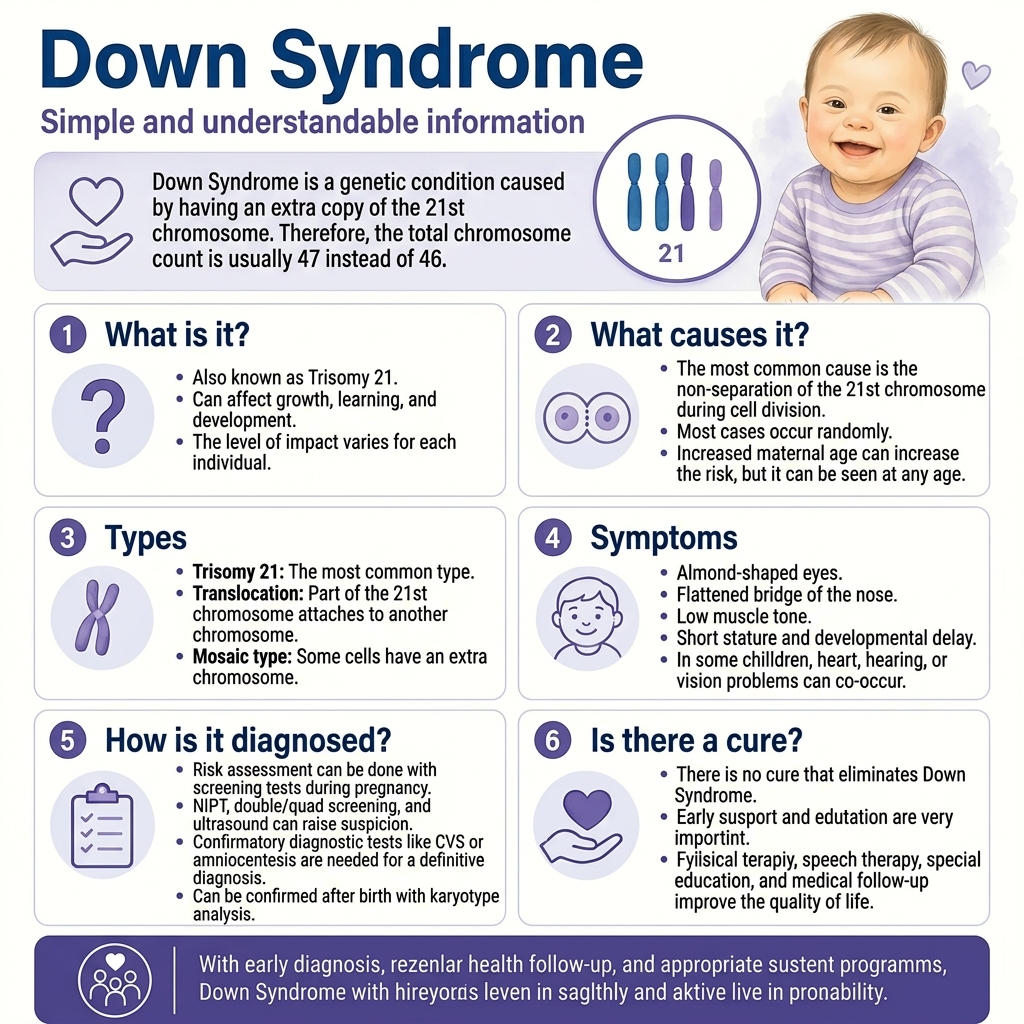
What is Down Syndrome?
Down syndrome is a genetic chromosome difference that occurs when there is an extra copy of chromosome 21 in the baby's cells. For this reason, Down syndrome is also known as Trisomy 21. While humans usually have 46 chromosomes, in Down syndrome the total number of chromosomes is most often 47.
This chromosome difference can affect the baby's physical appearance, growth, learning process, and some health conditions. However, the level of impact varies for each individual.
What Causes Down Syndrome?
The most common cause of Down syndrome is the non-disjunction of chromosome 21 during cell division, resulting in an extra chromosome 21. Most cases occur spontaneously and do not result from anything the parents did or did not do.
Advanced maternal age, especially 35 years and older, can increase the risk. However, babies with Down syndrome can be seen in pregnancies of all ages.
What Are the Types of Down Syndrome?
There are three main types of Down syndrome:
- Trisomy 21 — The most common type. There are three copies of chromosome 21 in the cells.
- Translocation Down syndrome — All or part of chromosome 21 is attached to another chromosome.
- Mosaic Down syndrome — An extra chromosome 21 is present in some cells, while the chromosome number is normal in other cells. Symptoms may be milder.
What Are the Symptoms of Down Syndrome?
Symptoms of Down syndrome can vary from person to person. The most common characteristics include:
- Slanted eyes appearance
- Flattened nasal bridge
- Small hands and feet
- Short neck
- Low muscle tone (hypotonia)
- Single palmar crease (Simian crease)
- Developmental delay and learning difficulties
In addition, some children may experience:
- Heart disease
- Hearing or vision problems
- Thyroid diseases
- Feeding problems
- Frequent infections
How is Down Syndrome Diagnosed?
The risk of Down syndrome during pregnancy can be evaluated with some screening tests. These include:
Double screening test, triple or quadruple screening test, ultrasound evaluation, and NIPT test.
These tests do not make a definitive diagnosis; they only perform a risk assessment. For a definitive diagnosis, diagnostic tests such as amniocentesis or chorionic villus sampling (CVS) are required.
After birth, the diagnosis can be confirmed by chromosome analysis / karyotype testing performed on the baby's blood sample.
Is There a Treatment for Down Syndrome?
There is no treatment that completely eliminates Down syndrome. However, supportive approaches starting at an early age can significantly increase the child's development and quality of life.
Physical therapy, speech therapy, special education, hearing and vision checks, regular pediatric follow-ups, and treatment of accompanying diseases are important parts of this process.